
Edward Llewellyn Books in Order
Browse Edward Llewellyn books in order, with quick summaries, Douglas Convolution background, and simple advice on where to start reading his science fiction.
Last updated:
As an Amazon Associate, we earn from qualifying purchases (at no extra cost to you).
Edward Llewellyn books in publication order
6 books
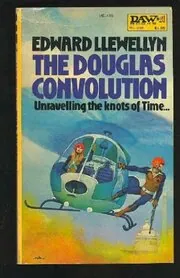
Douglas Convolution
by Edward Llewellyn
1979
Mathematician Ian Douglas discovers a way to slip through time and lands in a ravaged 2170. Trapped behind a false identity, he must navigate a fractured East Coast where remnants of science and power are still worth killing for.
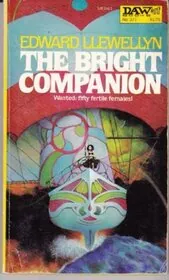
The Bright Companion
by Edward Llewellyn
1980
After a fertility disaster shrinks civilization, Anne kills the man who holds her captive and flees with David, a young scavenger whose hidden medicines make him valuable. Their search for a distant sanctuary becomes a rough, unpredictable journey across land and sea.

Prelude to Chaos
by Edward Llewellyn
1983
Former presidential bodyguard Gavin Knox and neurobiologist Judith Grenfell are locked in a near-escape-proof prison, each carrying secrets that could change humanity's future. Their breakout becomes a race to expose a biological threat before the surviving world tears itself apart.
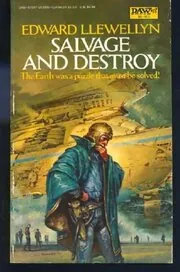
Salvage and Destroy
by Edward Llewellyn
1984
Earth's rapid expansion into space alarms the Ultrons, rulers of a vast interstellar cluster who have been watching from afar. Disguised as human, Lucian is sent to silence a hidden beacon and contain the threat, only to find the mission far messier than planned.
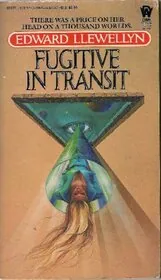
Fugitive in Transit
by Edward Llewellyn
1985
Ruth Thalia Adams, known as Alia, is on the run from the Galactic Transit Authority after learning too much about humanity's place in a wider network of worlds. Her flight across Earth turns into a chase tangled with romance, secrecy, and interstellar politics.
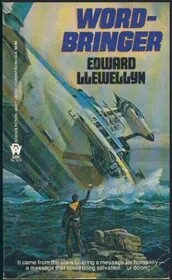
Word-bringer
by Edward Llewellyn
1986
Patent investigator Richard Ryan is hired to trace a burst of impossible scientific breakthroughs and uncovers evidence of alien contact. As he follows a strange probe and tests his own uncanny abilities, he has to decide whether this gift from the stars is help or a trap.
Where to start with Edward Llewellyn
If you want the core future-history arc: Douglas Convolution → The Bright Companion → Prelude to Chaos
If you want the collapse from the inside out: Prelude to Chaos → Douglas Convolution → The Bright Companion
If you want alien contact and larger-scale SF: Salvage and Destroy → Fugitive in Transit → Word-bringer
Edward Llewellyn sub-series and character series
Douglas Convolution books in order
Explore this seriesDouglas Convolution books in chronological order
Standalone Edward Llewellyn books
Author bio
Edward Llewellyn was the pen name of Edward Llewellyn-Thomas, a scientist, physician, teacher, and late-blooming science fiction writer. He was born in Salisbury, England, studied electrical engineering at the University of London, and entered adult life just as Europe was tipping into war.
World War II shaped his early years. He joined the British Army in 1939 and served as a radar and communications specialist with the Royal Electrical and Mechanical Engineers, seeing action in North Africa and the Far East. He rose to the rank of captain and later handled communications work in Gibraltar, the sort of job that rewards calm thinking, practical skill, and the ability to improvise when the equipment is not cooperating.
Then he changed lanes.
After the war he worked in telecommunications in Singapore, and while he was there he decided to train in medicine. In 1951 he and his wife Ellen moved to Montreal, where he entered McGill Medical School. He also worked at the Montreal Neurological Institute, helping build and use research equipment while learning medicine, and later practiced as a general doctor on a small island in the Bay of Fundy, sometimes traveling by fishing boat to reach patients.
By 1958 he was in Toronto, and his career widened again. He researched eye movements, aerospace medicine, psychopharmacology, and biomedical engineering, taught in several departments, and helped build early biomedical engineering work at the University of Toronto. Over the years he published about sixty scientific papers, co-edited a major textbook in the field, and became known as a gifted teacher with a warm, practical style.
He came to fiction late.
About six years before retirement, he started writing science fiction under the name Edward Llewellyn. In a run of six novels, he carried a lot of his working life onto the page: questions about technology, ethics, medicine, and what happens when smart systems fail ordinary people. Douglas Convolution, The Bright Companion, and Prelude to Chaos imagine a future Earth damaged by mass infertility, political breakdown, and fights over who gets to control the survivors.
His later books turn outward. Salvage and Destroy and Fugitive in Transit move toward first contact and interstellar politics, while Word-bringer, published after his death, follows an investigator pulled into an unsettling encounter with alien knowledge. Across these books, you can feel Llewellyn's interest in science as both a tool and a risk. He also gave a lot of space to capable women, scientists, and people trying to stay decent inside damaged systems.
That mix feels very close to the life he lived. Colleagues remembered his warmth, humor, and care for students, and in his final university years he worked in student affairs as well as research and teaching. He also published poetry in Welsh, which tells you something about the range of his interests.
Llewellyn-Thomas died in Toronto in 1984, only a few days after retiring from the University of Toronto. He left behind a small shelf of science fiction, but it is a memorable one, shaped by someone who had spent decades thinking about machines, medicine, perception, and human behavior before turning those questions into fiction.












Edited by
Software engineer whose passion for tracking book recommendations from podcasts inspired the creation of MRB.
Lead investor at 3one4 Capital whose startup expertise and love for books helped shape MRB and its growth.
Comments
Did we miss something? Have feedback?
Help us improve this page by sharing your thoughts