
Cyril Hare Books in Order
Explore Cyril Hare's books in order, with short summaries, series guides for Inspector Mallett and Francis Pettigrew, and simple advice on where to start.
Last updated:
As an Amazon Associate, we earn from qualifying purchases (at no extra cost to you).
Cyril Hare books in publication order
14 books
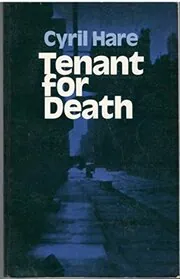
Tenant for Death
by Cyril Hare
1937
A disgraced financier is found dead in a South Kensington house rented under a false trail of identities. Inspector Mallett works through vanished tenants, shaky alibis, and money troubles in Hare's brisk, neatly engineered debut.
Death is No Sportsman
by Cyril Hare
1938
Inspector Mallett heads to fishing mad Didford Magna after a businessman dies among a party of anglers staying at the local inn. The rural setting is calm on the surface, but Hare turns it into a careful, clue driven murder case.
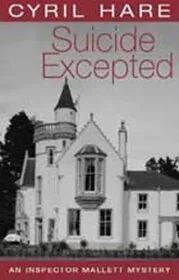
Suicide Excepted
by Cyril Hare
1939
An apparent sleeping pill suicide at a country hotel wipes out a valuable insurance payout, so the dead man's children set out to prove murder instead. Inspector Mallett drifts back into the case as the family's amateur inquiry deepens.
Tragedy at Law
by Cyril Hare
1942
A High Court judge on circuit begins receiving threats, poisoned chocolates, and worse. As the danger grows, barrister Francis Pettigrew and Inspector Mallett must sort out grudges, legal quirks, and a murder hidden inside professional ritual.
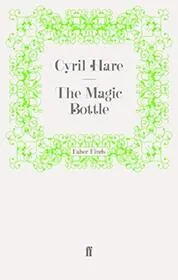
The Magic Bottle
by Cyril Hare
1946
Philip and Mary open a strange bottle in their grandmother's new house and let out a djinn. What follows is a light, comic fantasy of wishes, mishaps, and unexpected adventures in wartime England.
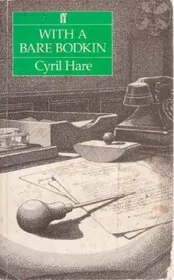
With a Bare Bodkin
by Cyril Hare
1946
At a wartime control board for pin manufacture, a make believe murder plot turns real when one of the participants is stabbed with a bodkin. Pettigrew and Inspector Mallett sort through office boredom, black market dealings, and grudges.
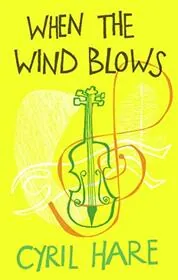
When the Wind Blows / The Wind Blows Death
by Cyril Hare
1949
Now settled in Markshire, Pettigrew is drawn into murder when visiting violinist Lucy Carless is strangled backstage during a concert. The suspects sit close at hand, and the trail runs through orchestra politics, gossip, and timing.

The Euthanasia of Hilary’s Aunt
by Cyril Hare
1950
Hard up Hilary Smyth sees opportunity in the illness of his wealthy aunt, and starts planning far too neatly. This short, darkly funny crime tale shows Hare's gift for legal irony and endings that bite.
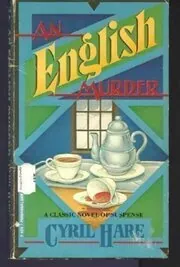
An English Murder
by Cyril Hare
1951
Snow cuts off Warbeck Hall just as the old viscount's heir dies at the dinner table. With more deaths to follow, a house full of aristocrats, politicians, and a visiting historian becomes a sharp, claustrophobic puzzle.
That Yew Tree's Shade / Death Walks the Woods
by Cyril Hare
1954
Pettigrew and his wife hope for peace in Yew Hill, but Easter visitors and the murder of a kindly local woman upset the village. The case mixes small town grudges, postwar change, and a quietly tricky puzzle.
He Should Have Died Hereafter / Untimely Death
by Cyril Hare
1958
While holidaying on Exmoor, Pettigrew finds a body that promptly vanishes. When it turns up again, an inheritance dispute, local suspicions, and retired Inspector Mallett turn the case into one of Hare's most tangled legal puzzles.

Best Detective Stories of Cyril Hare
by Cyril Hare
1959
Selected by Michael Gilbert, this collection is a strong entry point to Hare's short fiction. The stories are compact, clever, and often darkly funny, with neat twists and the same legal sharpness that runs through the novels.

Death Among Friends and Other Detective Stories
by Cyril Hare
1959
This posthumous collection gathers Hare's short mysteries and suspense tales, many built on small legal quirks, bad luck, and sly reversals. Some stories feature Inspector Mallett or Francis Pettigrew, but the real pleasure is the dry wit.
English Country House Murders
by Thomas Godfrey, Arthur Conan Doyle, Wilkie Collins, Robert Barr, Emma Orczy, R Austin Freeman, Gilbert Keith Chesterton, Agatha Christie, Dorothy L. Sayers, Ngaio Marsh, Margery Allingham, Freeman Wills Crofts, John Dickson Carr, Cecil Day-Lewis, PG Wodehouse, J. I. M. Stewart, Philip MacDonald, Ethel Lina White, Christianna Brand, Cyril Hare, Ruth Rendell, PD James & James G. Miles
1988
Edited by Thomas Godfrey, this anthology gathers classic British mystery stories set in and around country estates. The selection ranges from early detective fiction to later crime tales, with contributions from writers including Arthur Conan Doyle, Agatha Christie, Ngaio Marsh, Ruth Rendell, and P. D. James.
Where to start with Cyril Hare
If you want the classic legal mystery: Tragedy at Law → With a Bare Bodkin → He Should Have Died Hereafter / Untimely Death
If you want Inspector Mallett first: Tenant for Death → Death is No Sportsman → Suicide Excepted
If you want the snowbound standalone: An English Murder
If you want the full Francis Pettigrew run: Tragedy at Law → With a Bare Bodkin → When the Wind Blows / The Wind Blows Death → That Yew Tree's Shade / Death Walks the Woods
Cyril Hare sub-series and character series
Inspector Mallett and Francis Pettigrew books in order
Explore this series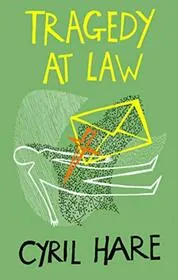
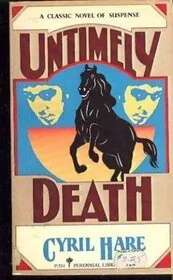
He Should Have Died Hereafter / Untimely Death
by Cyril Hare
1958Inspector Mallett and Francis Pettigrew, Book 2
Inspector Mallett and Francis Pettigrew books in chronological order
He Should Have Died Hereafter / Untimely Death
by Cyril Hare
1958Inspector Mallett and Francis Pettigrew, Book 2
Cyril Hare collections, short stories, and related book types
Short Stories/Novellas
Short Story Collections
Standalone Cyril Hare books
by Thomas Godfrey, Arthur Conan Doyle, Wilkie Collins, Robert Barr, Emma Orczy, R Austin Freeman, Gilbert Keith Chesterton, Agatha Christie, Dorothy L. Sayers, Ngaio Marsh, Margery Allingham, Freeman Wills Crofts, John Dickson Carr, Cecil Day-Lewis, PG Wodehouse, J. I. M. Stewart, Philip MacDonald, Ethel Lina White, Christianna Brand, Cyril Hare, Ruth Rendell, PD James & James G. Miles
1988
Author bio
Cyril Hare was the pen name of Alfred Alexander Gordon Clark, born in Mickleham, Surrey, in 1900, the third son of a family in the wine and spirit trade. He grew up in the same county he would later use so well in fiction, first at home in rural Surrey, then at St Aubyn's in Rottingdean and Rugby School, before reading History at New College, Oxford, where he took a first.
After Oxford he turned to law, was called to the Bar in 1924, and joined the chambers of Roland Oliver. That career mattered. Long before he wrote about judges, clerks, awkward witnesses, and technical points of procedure, he had seen how those worlds actually worked. Later he served as a judge's marshal, worked in wartime government and at the office of the Director of Public Prosecutions, and in 1950 became a county court judge in Surrey.
For years, the law paid the bills and supplied the plots.
He did not become a crime novelist especially young. Michael Gilbert later said Gordon Clark first wrote lighter pieces for magazines and only turned to detective fiction in his mid-thirties. His first novel, Tenant for Death, appeared in 1937 and introduced Inspector Mallett, a professional detective who is steady, observant, and pleasingly short on theatrics.
The pen name came from two London addresses, Hare Court, where he worked, and Cyril Mansions in Battersea, where he lived after his marriage to Mary Barbara Lawrence in 1933.
Hare's best known book is Tragedy at Law, first published in 1942 and still the title most often linked with his name. It introduced Francis Pettigrew, a barrister who is bright, decent, and never quite grand enough to fit the usual amateur sleuth mold. Hare drew on his own time as a judge's marshal for the novel's life on circuit, and readers still come to it for the combination of legal detail, human comedy, and a murder plot that tightens slowly and smartly.
Other books show the same knack for turning professional life into suspense. Suicide Excepted builds a whole mystery around an insurance clause. With a Bare Bodkin uses wartime bureaucracy and shortages as live material rather than background decoration. When the Wind Blows shifts into musical life, while An English Murder takes the old snowbound country house setup and gives it a distinctly postwar edge, full of class strain, politics, and fading certainty.
He also wrote short stories, many of them for the Evening Standard, and they share the same cool control. Even when the setup is grim, the writing is seldom heavy. There is usually a dry smile somewhere in the sentence. He even wrote one children's book, The Magic Bottle, which says something useful about him, the legal mind was real, but so was the playful side.
Readers who warm to Hare usually warm to his scale. His books are clever without showing off. His detectives, Mallett and Pettigrew, feel like working people, not legends. Money, inheritance, duty, embarrassment, and the small traps hidden in respectable institutions matter as much in his fiction as blood and shock.
He was elected to the Detection Club in 1946. After the Second World War he suffered from tuberculosis and never fully recovered, though he kept writing. He and Mary had three children, and he spent his later years back in Surrey, where he died near Box Hill in 1958, a week short of his fifty-eighth birthday.
Edited by
Software engineer whose passion for tracking book recommendations from podcasts inspired the creation of MRB.
Lead investor at 3one4 Capital whose startup expertise and love for books helped shape MRB and its growth.
Comments
Did we miss something? Have feedback?
Help us improve this page by sharing your thoughts