
Children of Time Books in Order
Part ofAdrian Tchaikovsky Books in OrderSee the Children of Time books in order by Adrian Tchaikovsky, with quick summaries, series background, and help choosing where to start this big-idea SF saga.
Last updated:
As an Amazon Associate, we earn from qualifying purchases (at no extra cost to you).
Children of Time books in publication order
4 books
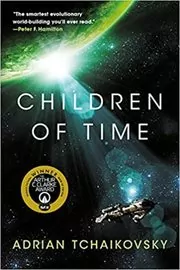
Children of Time
by Adrian Tchaikovsky
2015
Humanity’s last survivors reach a terraformed world meant to be their new home, only to find another civilization already there. The collision between desperate humans and rapidly evolved spiders drives one of Tchaikovsky’s biggest and strangest novels.
Recommended by
3 people PewDiePie recommended this book
PewDiePie
"Tackles some really interesting topics." - PewDiePie
PewDiePie's recommendation of this book  Ezra Klein recommended this book
Ezra Klein
Ezra Klein recommended this book on Twitter.
Ezra Klein's recommendation of this book  Brian Dean recommended this book
Brian Dean
"Mentally ill AI and sentient spiders await a broken down starship. Need I say more?" - Brian Dean
Brian Dean's recommendation of this book
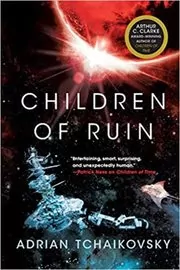
Children of Ruin
by Adrian Tchaikovsky
2019
Humanity and its spider allies follow old radio signals to the world called Nod, hoping to find cousins from Earth’s lost age. Instead they wake something ancient that was better left sleeping.
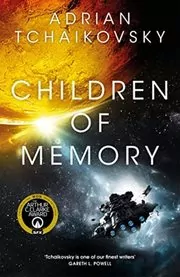
Children of Memory
by Adrian Tchaikovsky
2023
Visitors from the stars arrive at the lost colony on Imir, hoping to help and to learn. Instead they find memory gaps, fear, and a world whose history does not stay still long enough to trust.

Children of Strife
by Adrian Tchaikovsky
2026
A crew of humans, spiders, and a formidable mantis shrimp captain rediscovers a lost world and an ark from Earth’s deep past. Then Alis wakes to find most of the expedition gone and the answers below anything but friendly.
Children of Time books in chronological order
Series background & context
The Children of Time books start with a simple, unnerving question: if humanity remade the stars and then collapsed, who gets the future after us? Adrian Tchaikovsky takes that question very seriously, and very far.
In the first book, a terraformed world meant for humans does not stay empty. Evolution keeps moving, guided by old experiments and long stretches of time, until a new civilization rises where people expected a colony. That setup gives the series its trademark mix of huge timescales, hard science fiction, and genuine curiosity about nonhuman minds.
The next books keep widening the frame. Humans are no longer the only important intelligence in the story, and neither are the spiders. The sequence moves into lost colonies, broken terraforming projects, strange signals, half-understood archives, and encounters with species that do not think, remember, or communicate in the ways people expect. The result is not just first contact. It is contact over and over again, with all the misunderstanding that comes with it.
That is what ties the series together. These books care about evolution, ecology, language, memory, and the slow work of learning to share a universe with beings that are not built like us. There is action, horror, and real danger, but the deeper tension usually comes from trying to bridge different kinds of intelligence without flattening them into something comfortably human.
The later novels also lean into the arkship and lost-colony side of the setting. Whole societies have splintered away from old Earth, adapted badly or brilliantly, and developed myths around broken technology and old instructions. Children of Memory and Children of Strife push further into that territory, where survival, history, and perception all start to wobble.
So if you like science fiction that thinks big but still feels alive on the page, this is a very good place to settle in. Expect uplifted creatures, ancient mistakes, awkward alliances, grim expeditions, and a series that keeps asking the same hard question in new forms: can intelligence learn empathy before fear takes over?








Edited by
Software engineer whose passion for tracking book recommendations from podcasts inspired the creation of MRB.
Lead investor at 3one4 Capital whose startup expertise and love for books helped shape MRB and its growth.
Comments
Did we miss something? Have feedback?
Help us improve this page by sharing your thoughts