
Brian Greene Books in Order
Explore Brian Greene's books in order, with brief summaries, reading tips, and background on his writing about string theory, cosmology, and our universe.
Last updated:
As an Amazon Associate, we earn from qualifying purchases (at no extra cost to you).
Brian Greene books in publication order
7 books
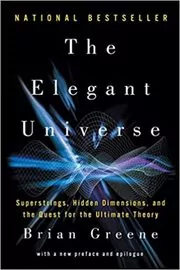
The Elegant Universe
by Brian Greene
1999
The Elegant Universe introduces string theory to general readers, explaining how tiny vibrating strings and extra dimensions might unify gravity with quantum physics. Greene uses everyday analogies and a historical tour of physics to make deep ideas feel approachable.
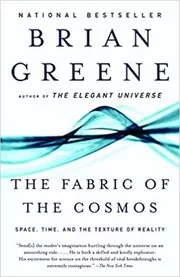
The Fabric of the Cosmos
by Brian Greene
2003
The Fabric of the Cosmos asks what space and time really are, moving from Newton's absolute stage to Einstein's spacetime and the strange behavior revealed by quantum theory. Greene uses everyday stories to unpack time's arrow, entanglement, and the foundations of reality.
Icarus at the Edge of Time
by Brian Greene
2008
Icarus at the Edge of Time reimagines the Icarus myth as a science-fiction story about a boy who flies his ship toward a black hole. Aimed at younger readers, it uses a fast adventure to introduce ideas about relativity and time.
The Hidden Reality
by Brian Greene
2011
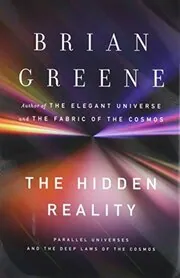
The Hidden Reality explores the possibility that our universe is one of many, surveying different kinds of multiverse suggested by inflationary cosmology, quantum mechanics, and string theory. Greene explains each idea's appeal, puzzles, and what it might mean for our place in reality.
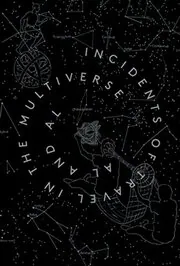
Al and Al
by Brian Greene
2016
Al and Al is a companion volume to the artists' project Incidents of Travel in the Multiverse, collecting stills, sketches, and essays around three visionary films. Brian Greene contributes scientific context as the book links black holes, artificial life, and parallel worlds.
Light Falls
by Brian Greene
2016
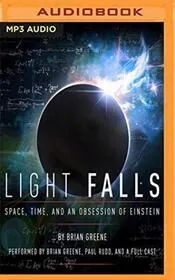
Light Falls presents a dramatic retelling of how Albert Einstein developed the general theory of relativity, based on Brian Greene's theatrical production. It blends narrative scenes with clear explanations to show how a new view of gravity reshaped modern physics.
Until the End of Time
by Brian Greene
2020
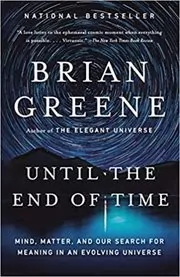
Until the End of Time traces the story of the cosmos from the big bang through the formation of matter, stars, life, and consciousness, then looks ahead to distant futures. Greene weaves physics, biology, and culture into a reflection on how humans seek meaning.
Where to start with Brian Greene
If you are new to Brian Greene: The Elegant Universe → The Fabric of the Cosmos
If you want a sweeping cosmic story and big questions about meaning: Until the End of Time → The Fabric of the Cosmos
If you are curious about parallel universes and the multiverse: The Elegant Universe → The Hidden Reality
If you are picking something for younger readers or classrooms: Icarus at the Edge of Time
If you enjoy science mixed with theater and art: Light Falls → Al and Al
Brian Greene collections, short stories, and related book types
Non-Fiction
by Brian Greene
1999Superstrings, Hidden Dimensions, and the Quest for the Ultimate Theory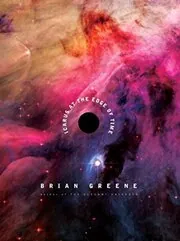
by Brian Greene
2020Mind, Matter, and Our Search for Meaning in an Evolving Universe
Standalone Brian Greene books
Author bio
Brian Greene was born in New York City in 1963 and grew up on Manhattan's Upper West Side, just across from the Hayden Planetarium. As a kid he split his attention between the bright lights of the city and the even brighter stars overhead.
His father, Alan, had been a vaudeville performer and later worked as a composer and vocal coach, and the house was full of music and big ideas. At the same time, Greene fell hard for numbers, spending afternoons working through long arithmetic problems for fun.
By grade school he could already handle calculations far beyond his years, and teachers let him race ahead in math and science. A field trip to the planetarium left him with a different kind of problem, the unsettling sense of how small Earth is in a vast universe.
He attended Stuyvesant High School in New York, then studied physics at Harvard, graduating summa cum laude in 1984. From there he went to Oxford as a Rhodes Scholar, completing a doctorate in theoretical physics focused on superstrings and the geometry of the universe.
Greene began his academic career at Cornell University before moving to Columbia University in the mid 1990s, where he is a professor of physics and mathematics and directs the university's center for theoretical physics. His research in string theory helped shape ideas about Calabi–Yau spaces, mirror symmetry, and how the topology of spacetime might change.
Alongside this technical work, he became known to a wide audience through a series of books that try to open modern physics to curious non specialists. The Elegant Universe introduces string theory and the hunt for a unified description of nature, while The Fabric of the Cosmos digs into what space and time really are.
The Hidden Reality turns to parallel universes, exploring ways a multiverse could emerge from inflation, quantum mechanics, and string theory. With Icarus at the Edge of Time, a short, illustrated reimagining of the Icarus myth set near a black hole, he began creating stories that help younger readers feel the drama of relativity.
In Until the End of Time, Greene steps back even further, tracing the history of the cosmos from the big bang through the rise of life and mind, then looking ahead to the far future. The book also reflects his interest in art, literature, and philosophy, asking how people find meaning in a universe that will not last forever.
Greene carries these themes into his public work as cofounder and chair of the World Science Festival, which brings scientists, artists, and audiences together in New York and beyond. He has hosted television specials, appeared on radio and talk shows, and written essays that argue science can nourish both curiosity and a sense of connection.
He lives in New York City with his family and continues to teach, write, and develop new ways to share physics with non scientists. For him, the joy lies in helping people see that abstract equations about space and time can still speak to everyday human questions.












Edited by
Software engineer whose passion for tracking book recommendations from podcasts inspired the creation of MRB.
Lead investor at 3one4 Capital whose startup expertise and love for books helped shape MRB and its growth.
Comments
Did we miss something? Have feedback?
Help us improve this page by sharing your thoughts