
11 Best Django Books
The best Django books, ranked by how many expert sources recommend each one, with notes on who each book suits and where to begin learning the framework.
Our take
Django brings database models, URL routing, templates, forms, and user accounts into one Python web framework. Learning those pieces is only the beginning: building a useful application also means testing behavior, managing permissions, and preparing a site for real users. The books here approach that work from different directions, so your Python experience and the kind of application you want to build matter more than choosing the longest guide.
Django for Beginners takes the gradual route through working websites. Django for APIs concentrates on backend services, while Django for Professionals moves into infrastructure and deployment. For larger projects, Django 5 By Example combines framework features with other tools. Test-Driven Development with Python teaches a development process rather than simply introducing framework features. Check the edition before following code, especially in books tied to older Django releases. Start with Django for Beginners if you know Python but haven’t built a Django site.
11 books · 8 sources · Last updated
As an Amazon Associate, we earn from qualifying purchases (at no extra cost to you).
How to choose from this list
Skip to the full rankingIf you know Python but are new to Django: Django for Beginners
If you want to build APIs: Django for Beginners → Django for APIs
If you want to prepare a site for deployment: Django for Professionals
If you want substantial practice projects: Django 5 By Example
If you want to learn testing habits: Test-Driven Development with Python
If you need faster database queries: The Temple of Django Database Performance
The 11 books, ranked
Ranked by how many expert sources name each book. Ties go to the book more people recommend.

For developers who want a focused introduction to Django REST Framework. Its small API projects build authentication and permissions into the learning path, though it spends less time on traditional template-driven websites.
What it's about
William Vincent teaches API development through progressively more detailed Django and Django REST Framework projects. Library, task-list, and blog APIs introduce authentication, permissions, documentation, viewsets, routers, testing, and preparation for deployment.

For Python learners who want their first complete Django websites. Its gradual project sequence connects framework concepts with working applications, though readers seeking architectural depth will need a follow-up after the introductory builds.
What it's about
William Vincent introduces Django through building websites from scratch, including a blog and newspaper application. Projects teach framework fundamentals, user accounts, forms, permissions, testing, and the steps needed to prepare a site for deployment.

For developers moving beyond introductory Django projects toward deployment and ongoing operation. Its bookstore example brings infrastructure and application concerns together, though the extra tools make it a demanding first encounter with the framework.
What it's about
William Vincent develops a bookstore application to explain the move from basic Django projects to production websites. Docker, PostgreSQL, user registration, email, permissions, and testing support practical guidance on preparing applications for real users.
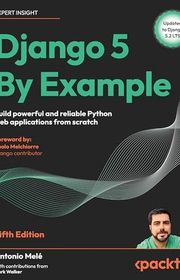
Django 5 By Example
For developers who know the basics and want larger applications that combine several technologies. Its four projects extend into background work and asynchronous features, though the length and breadth make it a substantial commitment.
What it's about
Four projects develop a blog, an image-sharing site, an online shop, and an e-learning platform with Django 5. Along the way, readers work with authentication, payments, background tasks, APIs, and real-time functionality beyond a basic website.

For developers interested in using Django as part of a smaller, API-centered application. Its mix of REST and real-time features broadens the architectural options, though the Backbone-based examples require substantial updating for modern projects.
What it's about
Julia Elman and Mark Lavin show how to build lightweight Django applications with REST APIs, Backbone, and WebSockets. Practical projects move from static prototypes to interactive single-page applications and real-time features.

Test-Driven Development with Python
Obey the Testing Goat Using Django, Selenium, and JavaScript
For developers who want to learn the discipline of writing tests before application code. Its sustained project links browser tests, unit tests, and refactoring, though the deliberate repetition makes progress slower than a framework tutorial.
What it's about
Harry Percival builds a web application through test-driven development, writing tests before the code that satisfies them. The book combines Python, Django, and Selenium with functional and unit testing, refactoring, deployment, and continuous integration.
Also recommended by
1 person Balaji Srinivasan recommended this book
Balaji Srinivasan
"Teaches you how to test things that are bigger than just a simple function." - Balaji Srinivasan
Balaji Srinivasan's recommendation of this book

Django Design Patterns and Best Practices
Industry-Standard Web Development Techniques and Solutions Using Python
For intermediate developers weighing how to structure maintainable Django applications. Its patterns connect design decisions with concrete framework code, though readers need enough Django experience to judge which solutions suit their own projects.
What it's about
Arun Ravindran examines design choices for secure, maintainable Django applications. Project examples cover models, views, templates, reusable code, APIs, asynchronous tasks, testing, security, and deployment, explaining patterns that address common development problems.

Django Unleashed
For readers who prefer a long explanation of how Django’s pieces fit together. Its complete website connects introductory concepts with advanced framework work, though older deployment and API examples need adaptation to current releases.
What it's about
Andrew Pinkham teaches Django by constructing and deploying a complete website. Models, templates, views, forms, and user permissions lead into more advanced work on security, performance, code reuse, and understanding the framework's architecture.

Mastering Django
For programmers who want a broad reference to Django’s components rather than a short introductory course. Its detailed framework coverage supports selective reading, though examples tied to older releases need checking against current documentation.
What it's about
Nigel George explains Django's core components and their advanced uses, from models, views, and templates to forms and administration. This programmer's reference also covers user management, database work, debugging, and testing.

The Temple of Django Database Performance
For Django developers whose main problem is slow database access. Its illustrated narrative makes query profiling and indexing more approachable than a conventional reference, though the narrow focus leaves general application development to other books.
What it's about
Andrew Brookins combines Django database tuning with a fantasy adventure through an illustrated temple. Examples and quizzes explain how to profile slow queries, choose indexes, and use the ORM efficiently with relational databases.

For developers maintaining Django 1.11 projects who want practical conventions for organizing applications. The topic-based chapters work well for reference, though version-specific examples need careful revision before use in a current application.
What it's about
Daniel and Audrey Roy Greenfeld collect practical patterns and coding advice for Django 1.11 projects. The guide addresses project organization, application design, settings, models, database queries, and function-based and class-based views.
Sources
- 1
Best Django Books (2025)
wsvincent.com
- 2
Best Django Books for Beginner and Advanced Programmers
techgeekbuzz.com
- 3
Django Books
goodreads.com
- 4
5 best Django books for all skill levels in 2021
sankalpjonna.com
- 5
Best Django Books (Beginner to Advanced) 2026 Edition
django.wiki
- 6
Django - Full Stack Python
fullstackpython.com
- 7
Best Books & YouTube Channels to Learn Django Framework (Beginner Friendly)
reddit.com
- 8
What is the best Django course today (beginner → advanced)? Books, video, blog… anything.
reddit.com





Edited by
Software engineer whose passion for tracking book recommendations from podcasts inspired the creation of MRB.
Lead investor at 3one4 Capital whose startup expertise and love for books helped shape MRB and its growth.
Comments
Spotted a missing book, a wrong order or a mistake? Tell us and we'll fix this page.
We're a reading guide, not the author or publisher, so we can't send books or pass on messages.