
World War II Liberation Trilogy Books in Order
Part ofRick Atkinson Books in OrderExplore Rick Atkinson’s Liberation Trilogy in order, with summaries, series background, and simple guidance on where to start his World War II narrative.
Last updated:
As an Amazon Associate, we earn from qualifying purchases (at no extra cost to you).
World War II Liberation Trilogy books in publication order
6 books

An Army at Dawn
by Rick Atkinson
2002
Atkinson traces the American and British campaigns in North Africa during 1942 and 1943, beginning with the landings in Morocco and Algeria. Battlefield setbacks, commanders' decisions, and soldiers' experiences show how an inexperienced Allied force developed under pressure.
An Army at Dawn: The War in North Africa, 1942-1943
by Rick Atkinson
2002
An Army at Dawn recounts the Allied invasion of North Africa, from the Torch landings in Morocco and Algeria to the brutal struggle for Tunisia. It shows a green American army learning hard lessons in coalition warfare and turning into an effective fighting force.

The Day of Battle
by Rick Atkinson
2007
This second volume of the Liberation Trilogy follows American and British armies through Sicily and Italy in 1943 and 1944. Atkinson examines strategic disagreements, the difficult battles at Salerno, Anzio, and Monte Cassino, and the campaign toward Rome.
The Day of Battle: The War in Sicily and Italy, 1943-1944
by Rick Atkinson
2007
Covering the campaigns in Sicily and mainland Italy, The Day of Battle follows Allied troops ashore on treacherous beaches and into mountain strongholds from Salerno and Anzio to Monte Cassino and Rome. Atkinson highlights the grinding combat, contested strategy, and human cost of fighting up the peninsula.
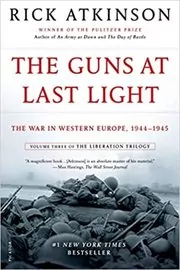
The Guns at Last Light
by Rick Atkinson
2013
Completing the Liberation Trilogy, Atkinson follows the Allied campaign in Western Europe from D-Day through the war's final stages. Normandy, Paris, Market Garden, and the Battle of the Bulge frame an account of command decisions, combat, and human costs.
The Guns at Last Light: The War in Western Europe, 1944-1945
by Rick Atkinson
2013
Completing the Liberation Trilogy, The Guns at Last Light opens with D-Day and follows Allied armies from the Normandy beaches through the liberation of Paris, Operation Market Garden, the Battle of the Bulge, and the final push into Germany.
World War II Liberation Trilogy books in chronological order

An Army at Dawn: The War in North Africa, 1942-1943
by Rick Atkinson
2002World War II Liberation Trilogy, Book 1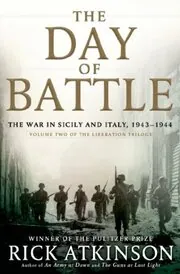
The Day of Battle: The War in Sicily and Italy, 1943-1944
by Rick Atkinson
2007World War II Liberation Trilogy, Book 2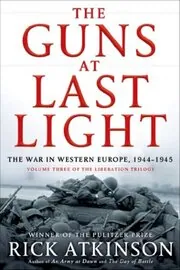
The Guns at Last Light: The War in Western Europe, 1944-1945
by Rick Atkinson
2013World War II Liberation Trilogy, Book 3
Series background & context
Rick Atkinson’s World War II Liberation Trilogy follows the U.S. and its Allies as they fight their way into Hitler’s Europe, beginning in North Africa and ending with Germany’s surrender. Instead of treating the war as a sequence of dates and operations, the books stay close to the people trying to make sense of a vast, brutal conflict.
The first volume, An Army at Dawn, covers the North African campaign of 1942–1943. It opens with the planning and execution of Operation Torch, the first major American landings in the European theater, and then traces the often chaotic fighting in Morocco, Algeria, and Tunisia. A largely inexperienced U.S. Army learns hard lessons under the eyes of commanders such as Eisenhower, Patton, Bradley, and Rommel, struggling with supply shortages, inter‑Allied friction, and the shock of modern mechanized warfare.
The Day of Battle moves the story to Sicily and mainland Italy. Atkinson follows Allied troops through hazardous amphibious landings and up the length of the peninsula, from places like Salerno and Anzio to Monte Cassino and Rome. The terrain is punishing, the weather often miserable, and German defenses stubborn; again and again, the narrative shows how strategy on maps translated into foxholes, destroyed towns, and long casualty lists.
The final book, The Guns at Last Light, begins with the buildup to D‑Day and follows the campaign in Western Europe through the liberation of Paris, Operation Market Garden, the Battle of the Bulge, and the crossing of the Rhine into Germany. Alongside famous set‑piece battles are quieter chapters on logistics, coalition politics, and the discovery of concentration camps as Allied armies push deeper into the Reich.
Across all three volumes, Atkinson relies heavily on diaries, letters, official reports, and after‑action notes to reconstruct events at every level, from presidents and generals to junior officers and riflemen. He is attentive to arguments within the Allied high command, the tensions between American and British approaches to the war, and the constant problem of feeding, arming, and moving immense armies over difficult ground.
The trilogy can be read straight through as a continuous history of the European war from 1942 to 1945, or dipped into volume by volume depending on a reader’s interests. An Army at Dawn received the Pulitzer Prize for history and helped bring the series to a wide audience, but each book stands on its own as a detailed portrait of a particular phase of the conflict. Readers should expect clear narrative, close attention to human experience, and a steady reminder of the cost that victory imposed on those who fought it.






Edited by
Software engineer whose passion for tracking book recommendations from podcasts inspired the creation of MRB.
Lead investor at 3one4 Capital whose startup expertise and love for books helped shape MRB and its growth.
Comments
Did we miss something? Have feedback?
Help us improve this page by sharing your thoughts