
Rodrigo Hasbun Books in Order
Browse Rodrigo Hasbun's books in order, with quick summaries, key themes, and clear guidance on where to start with his novels and story collections.
Last updated:
As an Amazon Associate, we earn from qualifying purchases (at no extra cost to you).
Rodrigo Hasbun books in publication order
2 books
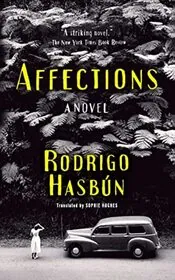
Affections
by Rodrigo Hasbun
2015
After World War II, the Ertl family flees Germany to Bolivia, where Hans chases lost cities and impossible dreams. As the family splinters, his eldest daughter Monika is pulled toward revolution, turning private loyalties into political danger.

So Much Water, So Far From Home
by Rodrigo Hasbun
2017
A rural getaway for a few middle-aged women slowly turns darker. As memories rise and danger edges nearer, Hasbun turns an ordinary trip into a tense story about vulnerability, friendship, and what lingers after violence.
Where to start with Rodrigo Hasbun
If you want the clearest place to start: Affections
If you like coming-of-age stories and memory: Los días más felices → The Invisible Years
If you want short, tense fiction: So Much Water, So Far From Home → Cinco
If you want his darker early work: El lugar del cuerpo → Affections
Rodrigo Hasbun collections, short stories, and related book types
Short Stories/Novellas
Standalone Rodrigo Hasbun books
Author bio
Rodrigo Hasbun was born in 1981 in Cochabamba, Bolivia, and a lot of his fiction keeps circling back to that city. He has written about its mountains, its markets, its long afternoons, and the strange mix of intimacy and distance that comes with growing up in a place you know by heart and still want to escape. Even when he writes from elsewhere, Cochabamba stays close.
He studied communications and journalism in Bolivia, then spent time in Santiago and later Barcelona, where he studied literary translation. Those moves mattered. Hasbun has said that he comes from a migrant family and that travel has marked his life since childhood, which helps explain why so many of his books are interested in displacement, memory, and the feeling of belonging to more than one place at once.
His publishing career started early, but it never looks rushed on the page. The first story collection, Cinco, came out in 2006. Then came the novel El lugar del cuerpo, followed by Los días más felices, Cuatro, and later Affections and Los años invisibles. Across those books, he tends to write in a tight, controlled way, with a sharp eye for what people hide from one another and from themselves.
He likes pressure points.
Families under strain, friendships at the edge of change, people living with private shame, old grief, or divided loyalties, these are the situations he returns to again and again. His stories can be political, but they usually stay grounded in ordinary scenes: a conversation that goes wrong, a silence that lasts too long, a memory that keeps pushing into the present.
Affections is the book that introduced many English-language readers to his work. Inspired by the real Ertl family, it follows a German family that settles in Bolivia after World War II and slowly comes apart under the weight of exile, ambition, and ideology. The novel won an English PEN Award, was translated widely, and shows one of Hasbun's strengths, his ability to bring history down to the level of rooms, meals, glances, and family habits.
Another side of his writing shows up in shorter work like So Much Water, So Far From Home, where a seemingly ordinary trip turns tense and threatening. In Los años invisibles, later translated as The Invisible Years, he returns to adolescence, class, desire, and the ways a single year can keep shaping adult life decades later. Readers who connect with Hasbun usually respond to that mix of compression and emotional depth. He rarely overexplains, and that restraint is part of the pull.
Film matters here too.
Two of his stories were adapted for the screen, and he has co-written several screenplays. He also co-wrote El visitante, which earned a screenplay prize at Tribeca. That connection to film makes sense when you read him: the scenes are cleanly built, the images stick, and the shifts in perspective feel precise rather than showy.
Academic work runs alongside the fiction. Hasbun earned a Ph.D. in Latin American Literature from Cornell University, with research focused on diaries and life-writing, and that interest shows in his books. He is drawn to the blurry line between fact and fiction, to the stories people tell about themselves, and to the ways memory can be both faithful and unreliable at the same time. He now teaches in Houston as an associate professor at the University of Houston.



Edited by
Software engineer whose passion for tracking book recommendations from podcasts inspired the creation of MRB.
Lead investor at 3one4 Capital whose startup expertise and love for books helped shape MRB and its growth.
Comments
Did we miss something? Have feedback?
Help us improve this page by sharing your thoughts