
Randall Munroe Books in Order
Explore Randall Munroe's books in order, with concise summaries, series guides, background on xkcd and What If?, and easy advice on where to start.
Last updated:
As an Amazon Associate, we earn from qualifying purchases (at no extra cost to you).
Randall Munroe books in publication order
8 books
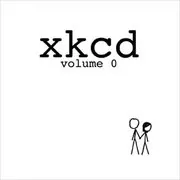
xkcd: volume 0
by Randall Munroe
2009
This first print collection gathers selected xkcd strips about science, technology, relationships, language, and everyday weirdness. Munroe's stick figures, charts, and quiet visual jokes reward both quick reading and closer inspection.
Recommended by
1 person Bill Gates recommended this book
Bill Gates
"This is one of two Randall Munroe books I’ve read, and it is (by design) the funnier of the pair." - Bill Gates
Bill Gates's recommendation of this book
Machine of Death: Stories About People Who Know How They Will Die
by Randall Munroe
2010
This anthology imagines a world where a blood test gives each person a cryptic but accurate prediction of death. The stories explore fate, fear, loopholes, and the trouble caused by knowing too much.
Feelings are boring, kissing is awesome.
by Randall Munroe
2012
This Dinosaur Comics collection returns to T-Rex, Utahraptor, Dromiceiomimus, and their shifting conversations about love, ethics, pop culture, and everyday nonsense. It also includes guest comics, including a contribution from Randall Munroe.
What If? Serious Scientific Answers to Absurd Hypothetical Questions
by Randall Munroe
2014
Readers send Munroe outlandish questions, from runaway physics problems to planetary disasters. He follows the real science as far as it goes, then illustrates the surprising, often catastrophic results with dry humor.
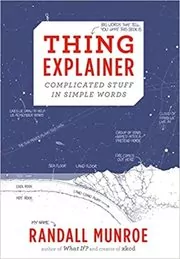
Thing Explainer
by Randall Munroe
2015
Randall Munroe uses labeled drawings and only the thousand most common English words to explain machines, cells, planets, and more. The constraint makes familiar science feel both clearer and funnier.
Recommended by
2 people Naval Ravikant recommended this book
Naval Ravikant
"Explains all these very complicated concepts, [but] only using the 1000 most common words in the English language." - Naval Ravikant
Naval Ravikant's recommendation of this book - Bill Gates recommended this book
Bill Gates
"Nuclear physics, space travel, and other topics made easy." - Bill Gates
Bill Gates's recommendation of this book
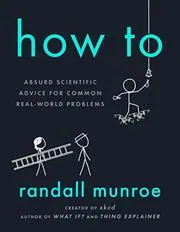
How To
by Randall Munroe
2019
Munroe tackles everyday tasks with deliberately terrible, overengineered solutions, such as moving house or crossing a river. Beneath the ridiculous plans are real lessons about physics, engineering, and the limits of practical advice.
What If? 2
by Randall Munroe
2022
A second batch of reader questions sends Munroe into freezer-door climate schemes, impossible structures, dinosaurs, geysers, and more. His research-driven answers use clear explanations and stick-figure drawings to make extreme scenarios understandable.
What If?
by Randall Munroe
Munroe applies mathematics, physics, and research to improbable questions submitted by readers of xkcd. Humorous explanations and cartoons explore extreme scenarios, from dangerous speed bumps to a dinosaur's appetite, while revealing the science behind the absurdity.
Recommended by
2 people- Bill Gates recommended this book
Bill Gates
"Munroe’s approach is a great way to learn about science." - Bill Gates
Bill Gates's recommendation of this book  Astro Teller recommended this book
Astro Teller
"The kids are obsessed with this. They can quote it from memory. They’ve learned probably more science from [this book] than they have from their science class in the last two years." - Astro Teller
Astro Teller's recommendation of this book
Where to start with Randall Munroe
For reader-submitted science questions: What If? → What If? 2
For clear, visual explanations: Thing Explainer → How To
For classic webcomic strips: xkcd: volume 0
For a dark fictional detour: Machine of Death
Randall Munroe sub-series and character series
What If? (Randall Munroe) books in order
Explore this series
What If? Serious Scientific Answers to Absurd Hypothetical Questions
by Randall Munroe
2014What If?, Book 1
What If? (Randall Munroe) books in chronological order
What If? Serious Scientific Answers to Absurd Hypothetical Questions
by Randall Munroe
2014What If?, Book 1
Randall Munroe collections, short stories, and related book types
Non-Fiction Books
Standalone Randall Munroe books
by Randall Munroe
Publication date unknownSerious Scientific Answers to Absurd Hypothetical Questions
Author bio
Randall Munroe was born in Easton, Pennsylvania, in 1984. His family spent time in Pennsylvania and Massachusetts before he finished high school in Midlothian, Virginia, a place that helped steer him toward physics, math, and the kind of questions that start small and quickly get out of hand.
He studied physics at Christopher Newport University, graduating in 2006. Before that, and for a time afterward, he worked on robots at NASA's Langley Research Center in Virginia. It was a useful fit for someone drawn to machines, space, and the strange edge cases hidden inside ordinary problems.
But Munroe was also drawing. In 2005, while still a student, he began posting comics online under the name xkcd. The early strips were spare, often built from stick figures, equations, awkward conversations, and jokes that trusted readers to keep up.
Then the comic became his full-time work.
xkcd grew into a home for science, technology, language, romance, maps, coding, and the peculiar rules people make for themselves. Some comics are quick jokes. Others turn into charts, thought experiments, or quiet stories about time and relationships. Readers tend to enjoy the way Munroe takes a technical idea seriously without treating it as too precious to laugh at.
His first print collection, xkcd: volume 0, brought selected strips to the page. He later expanded the question-and-answer side of his work with What If? Serious Scientific Answers to Absurd Hypothetical Questions, a book built around reader questions that are funny precisely because they demand real calculations. What happens if a baseball travels at nearly the speed of light? Could everyone jump at once and change the Earth's motion? Munroe follows the science, even when the answer ends in a very large explosion.
That mix of careful research and deadpan silliness runs through Thing Explainer, which uses only the thousand most common English words to explain complicated systems, and How To, a guide to solving everyday problems in wildly impractical ways. What If? 2 returns to reader questions, bigger hypotheticals, and the fun of seeing how far a sensible answer can be pushed.
He likes taking an idea all the way to its logical, unreasonable conclusion.
Munroe's work has also crossed into other corners of comics and science writing. His xkcd story “Time” received a Hugo Award for Best Graphic Story, and asteroid 4942 Munroe was named for him. Those are neat milestones, but they fit the larger picture: a former roboticist who kept sharing sketches and questions until they became a long-running body of work.
He has made his home in Massachusetts since the early years of xkcd. He continues to use simple drawings, serious research, and a willingness to ask the question that sensible people might be too embarrassed to say out loud.










Edited by
Software engineer whose passion for tracking book recommendations from podcasts inspired the creation of MRB.
Lead investor at 3one4 Capital whose startup expertise and love for books helped shape MRB and its growth.
Comments
Did we miss something? Have feedback?
Help us improve this page by sharing your thoughts