
Jean Flowers Books in Order
Explore Jean Flowers books in order, with short summaries, Postmistress Mystery reading order, series notes, and simple advice on where to start.
Last updated:
As an Amazon Associate, we earn from qualifying purchases (at no extra cost to you).
Jean Flowers books in publication order
3 books
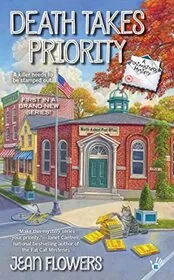
Death Takes Priority
by Jean Flowers
2015
After a breakup, Cassie Miller leaves Boston to run the post office in her Berkshire hometown. A break-in leads to stolen phone books, a body in the woods, and a murder case that hits close to her fresh start.
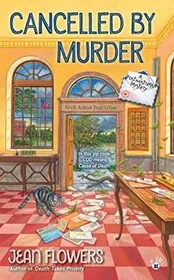
Cancelled by Murder
by Jean Flowers
2016
As a dangerous storm bears down on North Ashcot, Cassie Miller closes the post office and braces for damage. When a local shop owner turns up dead after the weather clears, Cassie follows the gossip toward a carefully hidden killer.
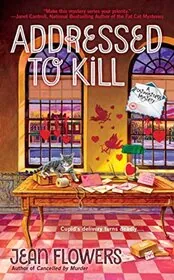
Addressed to Kill
by Jean Flowers
2017
Valentine's Day brings music and bustle to North Ashcot, until one of the local performers is found shot at home. Cassie Miller digs into break-ins, bad feeling, and small-town secrets before the holiday turns darker.
Where to start with Jean Flowers
If you want small-town mail and murder: Death Takes Priority → Cancelled by Murder → Addressed to Kill
If you like science at the center of the puzzle: The Hydrogen Murder → The Helium Murder → The Lithium Murder
If you prefer academic cozies: The Square Root of Murder → The Probability of Murder → A Function of Murder
If you enjoy craft-focused mysteries: Murder in Miniature → Mayhem in Miniature → Malice in Miniature
Jean Flowers sub-series and character series
Postmistress Mystery books in order
Explore this seriesPostmistress Mystery books in chronological order
Author bio
Jean Flowers was one of the pen names used by Camille Minichino, a mystery writer whose road to fiction was anything but straight. She was born and raised in Revere, Massachusetts, and if her books feel drawn to sharp minds, close communities, and patient puzzle solving, a lot of that came from the life she lived before publication.
Minichino earned a bachelor's degree in mathematics in 1958. She then joined the Sisters of Notre Dame and spent 18 years in the order. Along the way she studied at Fordham University, did experimental physics research in spectroscopy, and earned a Ph.D. in physics in 1968. Science was not a side note for her. It was the work she knew from the inside.
Then she changed lanes.
After leaving the order, she moved to California and built a long career at Lawrence Livermore National Laboratory. Over roughly three decades she worked in high-temperature and high-pressure physics, supported nuclear regulatory work, and taught across a surprisingly wide range of subjects, including physics, mathematics, philosophy, critical thinking, and interdisciplinary courses. She also edited technical material, taught writing workshops, and spent years helping other people explain complicated things clearly. That habit of making the difficult readable stayed with her fiction.
When she turned to mystery novels, she did not leave her earlier life behind. She used it. Her first series, opened by The Hydrogen Murder, follows retired physicist Gloria Lamerino, a sleuth who brings scientific thinking to murder cases in Massachusetts. Later books under her own name continued that mix of cozy mystery and lab savvy. Readers who like her science-based books usually respond to the same thing, the way the clues feel worked through step by step, without losing sight of character or place.
She also liked building series around the worlds she loved. As Margaret Grace, she wrote Murder in Miniature, starting a run of mysteries steeped in dollhouses and tiny crafted rooms. As Ada Madison, she published The Square Root of Murder, set in the academic world of math professor Sophie Knowles. And as Jean Flowers, she launched the Postmistress mysteries with Death Takes Priority, giving readers Cassie Miller, a former Boston postal manager trying to start over in a Berkshire town where even stolen phone books can lead to a killing. Much later, under Elizabeth Logan, she headed north again with Mousse and Murder.
Work mattered in her books.
Her sleuths are usually capable women with real jobs, real skills, and lives that do not stop just because a body turns up. She liked New England settings, classroom and workplace details, hobby communities, and the quiet tension that comes from people knowing one another too well. Even when the premise sounded playful, a physicist detective, a miniaturist, a postmaster, the appeal was grounded in everyday competence.
In her later years she lived in California, taught science at Golden Gate University, and continued teaching writing around the Bay Area. She also stayed curious. In her eighties, after decades of publishing, she went back to school for another master's degree in creative writing. She died on May 6, 2024, at 86. By then she had written nearly 30 mystery novels, plus short stories and nonfiction, and had shown just how much room there is between a lab bench, a classroom, and a very good murder puzzle.




Edited by
Software engineer whose passion for tracking book recommendations from podcasts inspired the creation of MRB.
Lead investor at 3one4 Capital whose startup expertise and love for books helped shape MRB and its growth.
Comments
Did we miss something? Have feedback?
Help us improve this page by sharing your thoughts