
FX Holden Books in Order
Explore FX Holden books in order, with summaries, series guides, and clear where-to-start advice for the Future War and Coruscant novels.
Last updated: 8 new books added
As an Amazon Associate, we earn from qualifying purchases (at no extra cost to you).
FX Holden books in publication order
18 books

Bering Strait
by FX Holden
2018
In 2031, Russia moves to seize the Bering Strait and pushes the United States toward a new Cold War turned hot. Pilots, diplomats, sailors, and a teen on St. Lawrence Island scramble to stop a conflict racing toward nuclear disaster.
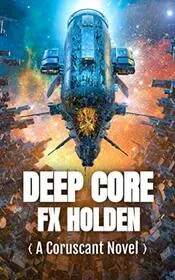
Deep Core
by FX Holden
2019
AJ is a cyber who wants a quiet life at a care facility on Tatsensui, with time for burgers and surfing. Then a new resident, a deadly assassin, and a notorious hacker drag him into a conspiracy that could reshape his world.
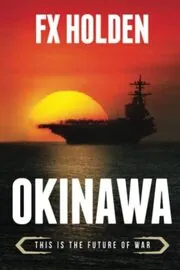
Okinawa
by FX Holden
2019
A landmark Sino-Japanese military exercise turns deadly when a hijacked drone targets US forces on Okinawa. Pilots on both sides, and a young woman thrust into imperial politics, race to prevent a regional crisis from becoming world war.
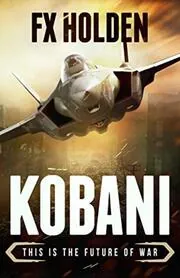
Kobani
by FX Holden
2020
Northern Syria becomes the flashpoint for a brutal proxy war as Russian-backed forces close in on Kobani and US allies are caught in the crossfire. Snipers, analysts, Marines, and pilots all face the same question, how local can this war stay?
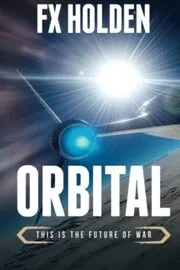
Orbital
by FX Holden
2020
After a meteor strike destroys Saudi oil infrastructure, suspicion falls on foreign powers and the fight moves into orbit. Space crews, spies, and pilots hunt the truth while the militarization of space threatens to ignite a wider war.

Core Drift
by FX Holden
2021
Fan Zhaofeng has remade himself as a healer, but a string of murders makes him the prime suspect. As investigator Lin Ming closes in, the two are pulled into a tense hunt for the real killer and the system behind the crimes.
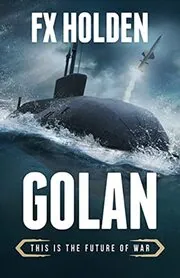
Golan
by FX Holden
2021
On the Golan frontier, old rivalries meet new weapons as Israel, Syria, Iran, and Russia edge toward open war. Cyber attacks, drones, and AI-driven systems cloud every decision, leaving soldiers and leaders guessing who struck first.
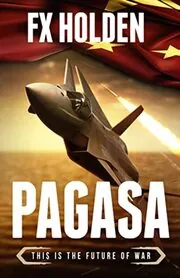
Pagasa
by FX Holden
2021
China moves on Pagasa Island, and Karen "Bunny" O'Hare is sent to protect a fragile convoy with a cutting-edge aircraft. What begins as a South China Sea standoff quickly turns into a fast, messy fight with global stakes.

Core Melt
by FX Holden
2022
Hunter Amin Wei was built for one job, find terror suspect Kristen Newgard and decide whether she deserves to die. His pursuit leads him into revolution, divided loyalties, and hard questions about who counts as human.
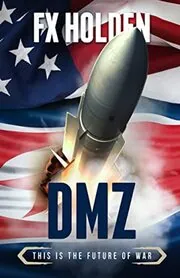
DMZ
by FX Holden
2022
A nuclear detonation over the Korean theater shatters fragile peace talks and throws the peninsula back toward war. Pilots, sailors, soldiers, and officials on both sides have only hours to stop panic, retaliation, and a slide into armageddon.
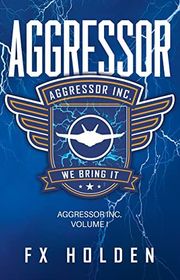
Aggressor
by FX Holden
2023
In 2038, China’s prolonged blockade of Taiwan threatens to overturn the regional balance of power. The United States promises an advanced weapons system to the island, leaving a pilot with the dangerous task of delivering it through Chinese defenses.
Beachhead
by FX Holden
2023
American troops arrive in Taiwan as missiles cross the strait, bringing China and a Western coalition toward open war. Combatants from several nations struggle to survive while leaders decide whether to retreat or turn the regional clash into global conflict.
Swarm
by FX Holden
2023
China deploys a devastating new weapon that the US coalition cannot counter, pushing Taiwan toward surrender. A fisherman believes he has found an answer, but must make someone listen while the battered Aggressor Squadron prepares for renewed danger.
Fulcrum
by FX Holden
2024
The war over Taiwan spreads across multiple fronts as rested Aggressor pilots return to combat. Fighting in Japan, Korea, and the Pacific coincides with domestic threats against the American president, while both sides prepare potentially decisive military operations.
Midnight
by FX Holden
2024
Taiwan approaches collapse as a special operations team prepares guerrilla warfare and a Sino-Russian fleet advances across the Pacific. American leaders face attacks on distant bases and organized unrest at home, with Hawaii becoming the next threatened battlefield.
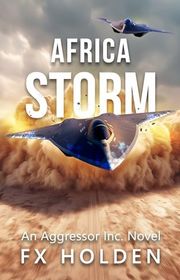
Africa STORM
by FX Holden
2025
Aggressor personnel train Sudanese forces as their government demands Russia withdraw from its Red Sea base. Advancing Russian troops and America’s new antimatter weapons raise the stakes, forcing soldiers and pilots to confront a dangerous escalation.

Antarctica STORM
by FX Holden
2025
A secret American research program beneath Antarctica develops a power source capable of immense destruction. Scientists and Aggressor crews face radiation anomalies, a possible spy, and a looming catastrophe as foreign adversaries move to disrupt the project.

Fiasco
by FX Holden
2025
Australian security officer Jack O’Hare tracks a wanted terrorist in Sydney and uncovers a much wider conspiracy. A missing American soldier, terrorist financing, and a rogue operative draw him across Australia into shifting loyalties and escalating danger.
Where to start with FX Holden
If you want the main entry point: Bering Strait → Okinawa → Orbital
If you want the story chronology: Kobani → Golan → Bering Strait → Okinawa
If you want the sharpest military flashpoints: Pagasa → DMZ
If you want AI-driven suspense: Deep Core → Core Drift → Core Melt
FX Holden sub-series and character series
Future War (FX Holden) books in order
Explore this seriesFuture War (FX Holden) books in chronological order
Standalone FX Holden books
Author bio
FX Holden is the thriller pen name of Australian writer Tim Slee, a former journalist and intelligence officer whose fiction blends geopolitics, future tech, and ordinary people having very extraordinary days. He was born in Papua New Guinea to Australian parents, with family roots in the sheep country of South Australia.
Before novels took over, Slee worked as a journalist in Adelaide and later held government roles in Canberra and Sydney. That mix of reporting, policy work, and intelligence experience helps explain why his books care so much about systems, chain of command, and the way big decisions land on individual lives.
He did not come to fiction by the usual straight line.
Under his own name, he built a broad writing career first. He won the Allen and Unwin INK Prize for short fiction, later took the BookLife Prize for his science fiction fantasy novel The Vanirim, and won the Banjo Prize for Taking Tom Murray Home. That novel showed a very different side of his work, more grounded in Australian life and character than in missiles, drones, or orbital warfare.
The FX Holden side of the story grew out of impatience as much as ambition. While waiting through the slow machinery of traditional publishing, he taught himself how to publish independently and released Bering Strait, a near-future military thriller about a US-Russia crisis in the Arctic. It found readers fast and opened the door to a long run of Future War novels, including Okinawa, Kobani, Orbital, Golan, Pagasa, and DMZ.
Those books usually start with a real-world pressure point and then push it just far enough into the future to feel alarming, but possible. A treaty, a blockade, a cyberattack, a contested island, a militarized orbit. Readers who click with Holden tend to like the same combination: plausible hardware, lots of moving parts, multiple points of view, and characters who have to make decisions before anyone fully understands the battlefield.
He also writes a quieter kind of science fiction.
The Coruscant novels, Deep Core, Core Drift, and Core Melt, lean more toward suspense and sci-fi noir. They explore artificial intelligence, cybernetic humans, surveillance, political control, and the simple but thorny question of who gets treated as fully human once the machines start thinking back. They are less about giant battles, more about pressure, pursuit, and moral gray areas.
A lot of his fiction seems to come from curiosity. He has said that ideas often begin with news stories, geopolitical questions, and the places he has lived and worked. He has spent time in Australia, Canada, and Denmark, and has described Australia as his physical and emotional home base, even when work takes him elsewhere.
That background matters. Holden writes about war, AI, and state power, but he keeps bringing the focus back to pilots, sailors, analysts, tech workers, and civilians who get caught inside those larger machines. The result is a body of work that can move from Taking Tom Murray Home to Kobani to Deep Core without feeling scattered, because in each case he is interested in people first, and the forces closing in around them second.












Edited by
Software engineer whose passion for tracking book recommendations from podcasts inspired the creation of MRB.
Lead investor at 3one4 Capital whose startup expertise and love for books helped shape MRB and its growth.
Comments
Did we miss something? Have feedback?
Help us improve this page by sharing your thoughts