
DA:C Books in Order
Part ofJF Holmes Books in OrderSee the DA:C books by JF Holmes in order, with summaries, series background, and a simple guide to where to start this cyber-military story.
Last updated:
As an Amazon Associate, we earn from qualifying purchases (at no extra cost to you).
DA:C books in publication order
1 book
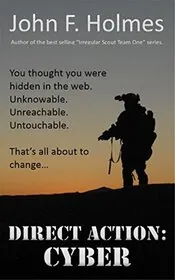
Direct Action
by JF Holmes
2015
Holmes mixes military action with cyber conflict in a story where digital threats spill into the real world. Plans unravel fast when the enemy can strike through systems as easily as through gunfire.
DA:C books in chronological order
Series background & context
DA:C looks like Holmes turning his military fiction toward the digital battlefield. The first book, Direct Action, carries the subtitle CYBER, which points pretty clearly toward a story where network attacks, electronic threats, and real-world violence are tied together instead of kept in separate boxes.
That blend makes sense for him.
A lot of Holmes's fiction is built around professionals working under pressure, and cyber conflict is a natural extension of that interest. In a story like this, the danger is not only the person kicking in the door. It is also the person inside a system, the bad code already planted, the communications failure at the worst possible time, or the decision made too late because nobody understood what was happening on the screen. Even with limited series material available, that feels like the central promise of DA:C, modern action where keyboards and rifles are part of the same fight.
The likely setting is near-future or contemporary military thriller territory. That means readers can probably expect command structures, mission planning, team-level action, and the awkward overlap between technical specialists and field operators. Holmes is usually strongest when showing how groups function under strain, and a cyber-focused story gives him another kind of pressure to play with. The enemy may be hidden, remote, or embedded in systems everyone depends on, but the consequences still land in physical space, with broken infrastructure, blown missions, and people caught at the point of failure.
What makes a cyber-military story work is not usually the jargon. It is whether the threat feels connected to human decisions. That is why DA:C has an interesting place in Holmes's catalog. His books tend to care about chain of command, improvisation, and the cost of bad assumptions. Cyber conflict is full of those things. Somebody misses a clue. Somebody trusts the wrong feed. Somebody thinks the crisis is contained until boots hit the ground and prove otherwise.
The tone is likely brisk and tactical rather than heavily technical. Holmes is not the sort of writer who disappears into diagrams for their own sake. The draw is momentum, teams, and escalating stakes. You read to see how the operation holds together, what goes wrong, and whether the people involved can adapt before the hidden part of the attack becomes the only thing that matters.
Because this is a smaller corner of his work, DA:C also feels like a compact entry point for readers who want the Holmes style without committing to a long sequence. You get the military flavor, the pressure, and the action, but filtered through a different kind of threat.
In short, DA:C appears to be about modern conflict where the battlefield is both physical and invisible, and the people caught in the middle have to fight on both fronts at once.















Edited by
Software engineer whose passion for tracking book recommendations from podcasts inspired the creation of MRB.
Lead investor at 3one4 Capital whose startup expertise and love for books helped shape MRB and its growth.
Comments
Did we miss something? Have feedback?
Help us improve this page by sharing your thoughts