
Cider House Rules Books in Order
Part ofJohn Irving Books in OrderThe Cider House Rules books by John Irving, centering on the moral complexities of an orphanage in rural Maine.
Last updated:
As an Amazon Associate, we earn from qualifying purchases (at no extra cost to you).
Cider House Rules books in publication order
2 books
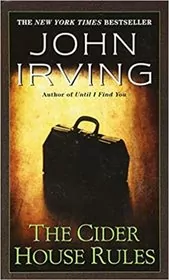
The Cider House Rules
by John Irving
1985
Homer Wells grows up in an orphanage run by Dr. Larch, an abortionist and ether addict. Homer eventually leaves to find his own path in an apple orchard, forcing him to confront the moral rules he was raised with.

Queen Esther
by John Irving
2025
Esther Nacht, a Jewish orphan at St. Cloud's, is adopted by the Winslow family. This historical novel follows her life and her son's journey, weaving together themes of anti-Semitism, identity, and political history.
Cider House Rules books in chronological order
Series background & context
Set in the bleak, snowy isolation of rural Maine, The Cider House Rules establishes a world that feels entirely cut off from the rest of the twentieth century. The story anchors itself at St. Cloud’s, a logging camp turned orphanage that creates a grim but necessary sanctuary. It is a place of unwanted children and desperate women, presided over by the complex figure of Dr. Wilbur Larch.
Larch is one of John Irving’s most memorable creations. He is an obstetrician, a heavy user of ether, and a man driven by a rigorous, if illegal, moral code. He delivers babies for mothers who cannot keep them, but he also performs safe abortions for those who cannot have them. To Larch, this is simply the "Lord’s work" and the "Devil’s work," duties he accepts equally to save women from the brutality of back-alley butchers.
Enter Homer Wells.
Homer is the orphan who never leaves. After several failed adoption attempts—he is always returned—he becomes a permanent fixture at St. Cloud’s, eventually evolving into Larch’s surrogate son and apprentice. Under Larch’s tutelage, Homer becomes an expert physician in everything but name. However, a deep philosophical rift forms between them. While Homer executes standard medical procedures with skill, he refuses to perform abortions, believing firmly in the sanctity of potential life.
This disagreement propels the narrative outward.
Homer eventually leaves the protective, sterile bubble of the orphanage to engage with the wider world. He lands at Ocean View Orchards, a working apple farm on the coast. Here, the story shifts gears, immersing Homer in the sensory overload of the cider house, the camaraderie of migrant labor, and a tangled romantic triangle with a young couple named Wally and Candy. It is in the bunkhouse that Homer encounters the literal rules taped to the wall—strict regulations that the illiterate workers cannot read and therefore ignore.
This sets up the novel’s central metaphor. The characters must decide whether to follow the rules written by distant authorities or to forge their own moral codes based on the messy, immediate realities of their lives. Homer discovers that the clear-cut morality he held at St. Cloud’s does not always survive contact with the complex, often tragic nature of the outside world.
Ultimately, the narrative is a sprawling journey of self-discovery and acceptance. It explores the idea of being of use. As Homer navigates love, loss, and the inevitability of fate, he is drawn back to the hard questions raised by Dr. Larch. The story remains a profound examination of choices, consequences, and the definition of family.





Edited by
Software engineer whose passion for tracking book recommendations from podcasts inspired the creation of MRB.
Lead investor at 3one4 Capital whose startup expertise and love for books helped shape MRB and its growth.
Comments
Did we miss something? Have feedback?
Help us improve this page by sharing your thoughts