
Bruce Alexander Books in Order
Browse Bruce Alexander books in order, with short summaries, Sir John Fielding series background, and simple advice on where to start reading.
Last updated:
As an Amazon Associate, we earn from qualifying purchases (at no extra cost to you).
Bruce Alexander books in publication order
11 books
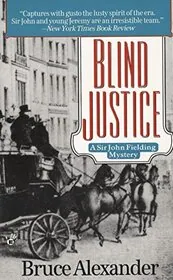
Blind Justice
by Bruce Alexander
1994
Falsely accused of theft in 1768 London, orphaned printer's apprentice Jeremy Proctor finds unexpected help in blind magistrate Sir John Fielding. As Jeremy is drawn into his first investigation, the series' sharp partnership takes shape.
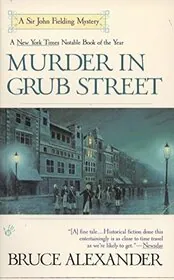
Murder in Grub Street
by Bruce Alexander
1995
A printer, his family, and two apprentices are slaughtered in a locked house, with a mad poet found holding a bloody axe. Sir John and young Jeremy look past the obvious answer and find a darker truth underneath.
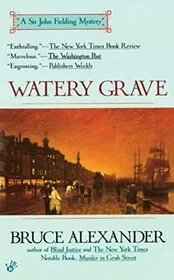
Watery Grave
by Bruce Alexander
1996
Sir John's stepson returns from sea with a story about a captain lost overboard, and the magistrate is asked to decide whether it was accident or murder. The inquiry opens onto naval life, ambition, and secrets carried home from the voyage.
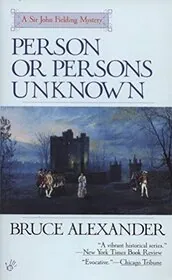
Person or Persons Unknown
by Bruce Alexander
1997
Women are being murdered around Covent Garden, and Sir John devises a risky plan to trap the killer. What begins as a hunt for a predator soon turns painfully personal for Jeremy and the people around Bow Street.
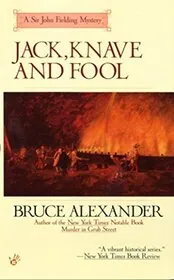
Jack, Knave and Fool
by Bruce Alexander
1998
A lord dies at a concert, then a severed head turns up by the Thames. As Sir John and Jeremy link the two deaths, they uncover greed, deception, and the overlap between polite society and the city's darker corners.
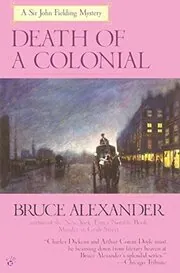
Death of a Colonial
by Bruce Alexander
1999
After a nobleman's execution, a man appears from the American colonies claiming the family estate. Sir John and Jeremy follow the case from London to Bath and Oxford, trying to decide whether the heir is genuine or deadly trouble.
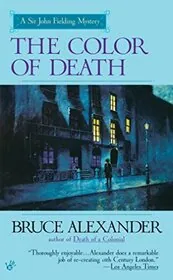
The Color of Death
by Bruce Alexander
2000
A violent gang is robbing and killing across London, and the chief clue points to black men in a slaveholding empire ready to jump to conclusions. After Sir John is wounded, Jeremy must carry the case forward.
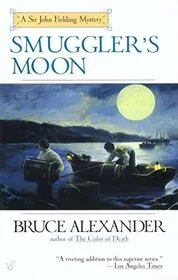
Smuggler's Moon
by Bruce Alexander
2001
In the seaside town of Deal, Sir John investigates murder, smuggling, and corruption in a place where the law and the contraband trade are tightly tangled. The coastal setting gives this case a rough, windblown feel.
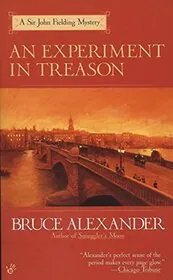
An Experiment In Treason
by Bruce Alexander
2002
Stolen letters, a dead suspect, and rising tension with the American colonies pull Sir John and Jeremy into a politically charged investigation. Benjamin Franklin stands near the center, and the truth tests the limits of law and loyalty.
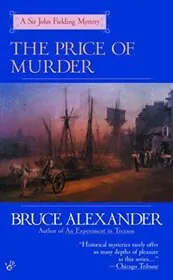
The Price of Murder
by Bruce Alexander
2003
When a young girl's body is pulled from the Thames, Sir John sends Jeremy into Seven Dials and the racetrack world tied to her missing mother. The case grows more dangerous when someone close to Jeremy disappears.
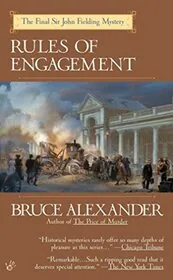
Rules of Engagement
by Bruce Alexander
2005
Lord Lammermoor's leap from Westminster Bridge looks like suicide, but Sir John suspects something darker. Jeremy digs into the Lammermoor family, a mesmerist's arrival, and a tangle of motives around a very public death.
Where to start with Bruce Alexander
If you want the full story: Blind Justice → Murder in Grub Street → Watery Grave
If you want gritty Georgian London: Murder in Grub Street → Person or Persons Unknown → Jack, Knave and Fool
If you want politics and empire: Death of a Colonial → The Color of Death → An Experiment In Treason
If you want later, darker cases: Smuggler's Moon → The Price of Murder → Rules of Engagement
Bruce Alexander sub-series and character series
Author bio
Bruce Alexander was the pen name Bruce Cook used for his fiction, especially the Sir John Fielding mysteries. Born in Chicago in 1932, he spent parts of his childhood in Chicago and in California, including Berkeley and Dunsmuir. He later earned a degree in English literature in Chicago, and that mix of places seems to fit the range of his career, because he was never just one kind of writer for long.
Before the novels, there was a lot of working life.
In the 1950s he served in Germany as a translator with the U.S. Army. After that he moved into journalism, working in Washington, D.C., and later Los Angeles, writing and editing across books, film, and music. He spent years with newspapers and magazines, including the National Observer, the Los Angeles Daily News, and Newsweek, and he also reviewed widely for major papers.
He came to books through nonfiction first. The Beat Generation arrived in 1971, followed by Listen to the Blues, Dalton Trumbo, and Brecht in Exile. Those books show the habits that stayed with him in fiction too, curiosity, a good ear, and a reporter's instinct to keep digging when a simple answer does not quite hold.
He also spent time in Europe again and again, especially in Paris, Normandy, and England. That mattered. His work, even when it is tightly plotted, has the feel of somebody who liked walking around, listening, and storing away details for later.
Fiction took its time.
His first novel, Sex Life, came out in 1979. Later he found a stronger groove in crime fiction with the Chico Cervantes books, beginning with Mexican Standoff. Set around Los Angeles and the border, those novels put a Mexican American investigator at the center of the action, and they already show Cook's interest in cities, class, and people moving between different worlds.
The big turn came when he found Sir John Fielding in a history book in 1977. He kept thinking about the real blind magistrate who helped shape the Bow Street Runners, and by the early 1980s he had the framework for a series. When Blind Justice appeared in 1994 under the name Bruce Alexander, it opened the door to the work many readers know him for best.
Those books are historical mysteries, but they read with the snap of lived experience. In Murder in Grub Street, Person or Persons Unknown, and The Color of Death, readers get murder plots, yes, but also crowded streets, working printers, prostitutes, thieves, servants, aristocrats, and all the messy friction of Georgian London. The partnership between Sir John and young Jeremy Proctor is a big part of why the series works so well. One sees with his mind, the other learns to see the city as it is.
He kept that series going through The Price of Murder, published in 2003. Cook had moved to Los Angeles in 1983 and lived there for the rest of his life, while still making time for journalism, criticism, and new books. He died of a stroke in Los Angeles on November 9, 2003.
A final Sir John Fielding novel, Rules of Engagement, was published after his death. Looking back, what stands out is range, biography, music writing, criticism, modern crime fiction, and then the rich 18th-century world of Sir John Fielding. He wrote like someone who enjoyed history, but liked people even more.








Edited by
Software engineer whose passion for tracking book recommendations from podcasts inspired the creation of MRB.
Lead investor at 3one4 Capital whose startup expertise and love for books helped shape MRB and its growth.
Comments
Did we miss something? Have feedback?
Help us improve this page by sharing your thoughts