
Bill Napier Books in Order
See Bill Napier books in order, with short summaries of his science thrillers and nonfiction, reading tips, and simple advice on where to start.
Last updated:
As an Amazon Associate, we earn from qualifying purchases (at no extra cost to you).
Bill Napier books in publication order
8 books
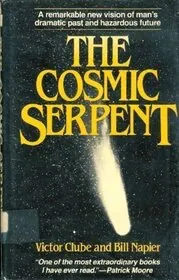
The Cosmic Serpent
by Bill Napier
1982
Written with Victor Clube, this book lays out an early catastrophist view of Earth history. It links comet impacts, myth, and geological upheaval, asking how often events in the sky have changed life on Earth.

The Cosmic Winter
by Bill Napier
1990
Written with Victor Clube, this book argues that giant comets and their debris may have shaped climate, history, and extinction events. It blends astronomy, geology, and old records into a wide-ranging look at cosmic risk.

The Origin of Comets
by Bill Napier
1990
Co-written with fellow astronomers, this study traces ideas about comets from the ancient world to modern science. It then examines where comets come from, how their orbits evolve, and why they matter so much.

Nemesis
by Bill Napier
1998
Physicist Oliver Webb has five days to stop an asteroid aimed at the United States. As political panic rises and a colleague turns up dead, he discovers that a missing seventeenth-century manuscript may hold the only answer.

Revelation
by Bill Napier
2000
Fred Findhorn lands on an Arctic iceberg to recover a dead scientist and a missing briefcase from a 1944 crash. Instead he stumbles into a lethal hunt for secrets with the power to reshape history, or end it.

The Lure
by Bill Napier
2002
A secret research team receives particle bursts that look like a message from beyond Earth. Irish mathematician Tom Petrie must help decode it while powerful forces move to suppress a discovery that could change humanity.

Splintered Icon
by Bill Napier
2004
Antique map dealer Harry Blake appraises a 400-year-old journal, then finds himself in the wake of murder. With marine historian Zola Kahn, he follows a trail of Elizabethan conspiracies and religious secrets that could ignite worldwide violence.

The Furies
by Bill Napier
2009
When something crashes into an Arizona canyon and releases anthrax, investigators turn to former spy Lewis Sharp. He traces the attack back to Nazi bioweapons and a buried wartime plot, with just days to stop a second catastrophe.
Where to start with Bill Napier
If you want the classic Bill Napier thriller: Nemesis → Revelation
If you like first-contact ideas and hard science: The Lure
If you want secret manuscripts and historical intrigue: Splintered Icon
If you want wartime conspiracy and bioweapon suspense: The Furies
If you want the science behind the fiction: The Cosmic Serpent → The Cosmic Winter → The Origin of Comets
Bill Napier collections, short stories, and related book types
Non-Fiction
Standalone Bill Napier books
Author bio
Bill Napier was born in Perth, Scotland, in 1940, and he first made his name not as a novelist but as an astronomer. He studied astronomy at Glasgow University and spent most of his working life at observatories in Scotland, Italy, and Northern Ireland. Long before he was writing thrillers, he was thinking about comets, asteroids, and the uneasy fact that Earth lives in a busy neighborhood.
Science came first.
A big part of Napier's research life centered on cosmic hazard. He was one of the early astronomers pushing the idea that comet and asteroid impacts deserved serious attention, not just as ancient events but as real risks. He was also involved with Spaceguard UK, and much of his work asked a question that sounds like the start of a thriller because, in a way, it is: how often has the sky changed life on Earth?
That same question runs through his nonfiction. In books such as The Cosmic Serpent, The Cosmic Winter, and The Origin of Comets, he explored comet science, Earth's past, and the possibility that cosmic debris has shaped climate, extinction, and human memory more than we like to think. Even when readers disagree with parts of the argument, the scale of the thinking is easy to see.
Then he turned those ideas loose in fiction.
Napier began publishing thrillers under the name Bill Napier in the late 1990s, starting with Nemesis in 1998. It feels like a natural move. His novels take the lab, the observatory, the archive, and the government bunker, then add a clock that is always running down. Scientists, mathematicians, historians, and code-breakers are his kind of heroes, and he likes giving them problems that sit somewhere between cutting-edge research and old buried secrets.
You can see that clearly across the novels. Nemesis turns an asteroid threat into a high-speed global crisis. Revelation mixes wartime science, Arctic recovery, and a deadly chase for hidden knowledge. The Lure starts with what may be a message from beyond Earth, while Splintered Icon follows a map dealer and a historian into manuscripts, religious intrigue, and murder. Later, The Furies brings Nazi bioweapons and modern catastrophe together in one more race against time.
What readers often respond to is the blend. Napier's books are full of big ideas, but they aren't just idea machines. He likes clues, puzzles, missing documents, strange research facilities, and the moment when a very smart person realizes the world is far more dangerous than it looked that morning. His stories move between Scotland, the Arctic, Eastern Europe, observatories, crash sites, old churches, and secret labs, yet they stay grounded in the habits of people who have to think their way out of trouble.
There's a reason the science feels lived in.
Napier spent decades inside the working world that feeds these books, and he has also held honorary roles in astrobiology. An asteroid, 7096 Napier, was named after him, which is a neat detail for a writer so interested in what the sky can throw at us. He has lived in Southern Ireland with his wife and has divided his time between writing, research with colleagues in the UK and California, and, by his own account, cooking, though he has said the competition at home is stiff.













Edited by
Software engineer whose passion for tracking book recommendations from podcasts inspired the creation of MRB.
Lead investor at 3one4 Capital whose startup expertise and love for books helped shape MRB and its growth.
Comments
Did we miss something? Have feedback?
Help us improve this page by sharing your thoughts