
Allen Drury Books in Order
Explore Allen Drury books in order, with short summaries, series guides, and tips on where to start with his Washington dramas and other novels.
Last updated:
As an Amazon Associate, we earn from qualifying purchases (at no extra cost to you).
Allen Drury books in publication order
24 books
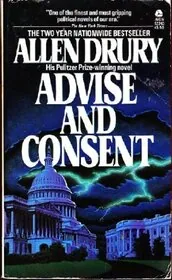
Advise and Consent
by Allen Drury
1959
A controversial nominee for Secretary of State goes before the Senate, and every hearing exposes another layer of ambition, fear, and compromise. Drury turns procedure into suspense as Washington edges toward crisis.
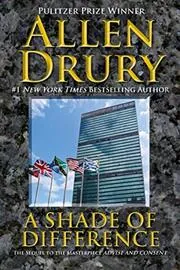
A Shade of Difference
by Allen Drury
1962
Drury widens his Washington canvas to the United Nations, where Cold War maneuvering collides with newly independent nations and America's own racial tensions. It is a sequel that makes global diplomacy feel personal and volatile.

That Summer
by Allen Drury
1965
Major Bill Steele arrives at an exclusive Sierra vacation colony hoping to recover from divorce. Instead he is pulled into the private politics of wealthy Greenmont, where loneliness, pressure, and desire turn a summer romance dangerous.
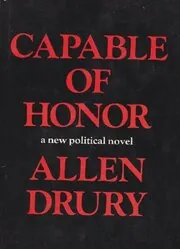
Capable of Honor
by Allen Drury
1966
President Harley Hudson runs for a term of his own while foreign crises and a ruthless media battle reshape the campaign. Party convention politics, public image, and ambition make this one of Drury's sharpest election novels.
A Very Strange Society
by Allen Drury
1967
Drury travels through South Africa and uses reporting, interviews, and official documents to examine the country's politics and social order. It is a searching portrait of a society built on deep contradictions.
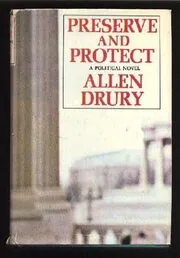
Preserve & Protect
by Allen Drury
1968
After President Harley Hudson dies in a suspicious crash, a bruising fight breaks out over who should lead his party and the country. The book drives toward a shocking burst of gunfire that splits the series in two.
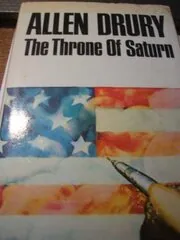
The Throne of Saturn
by Allen Drury
1970
An American plan to reach Mars turns urgent when the Soviets appear ready to get there first. Astronaut training, media battles, sabotage, and politics all crowd into a tense space-race thriller.
Courage and Hesitation
by Allen Drury
1972
Drawn from interviews and paired with Fred J. Maroon's photographs, this book offers a mid-first-term portrait of Richard Nixon and his White House. It is part political study, part visual record of an administration in motion.

Come Nineveh, Come Tyre
by Allen Drury
1973
In Drury's other continuation of Preserve and Protect, Ted Jason enters the White House promising peace and reconciliation. Idealism quickly meets violence, unrest, and hard power at home and abroad.

The Promise of Joy
by Allen Drury
1975
In this alternate sequel to Preserve and Protect, Orrin Knox reaches the presidency after an assassin reshapes American politics. Even as he takes office, a dangerous contest between the Soviet Union and China threatens to box him in.
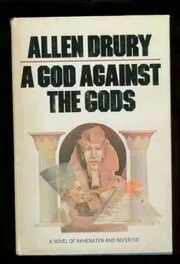
A God Against the Gods
by Allen Drury
1976
Akhenaten tries to break the power of Egypt's old religion and build a new order around the Aten. Drury tells the story through many voices, turning a distant dynasty into a vivid struggle over faith and power.
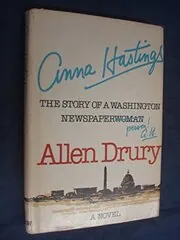
Anna Hastings
by Allen Drury
1977
Anna arrives on Capitol Hill as a young reporter on the day America enters World War II, then fights her way into the center of Washington media. The novel follows her climb from outsider to powerful publisher and commentator.
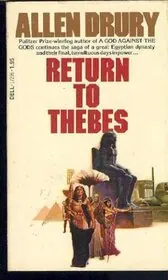
Return To Thebes
by Allen Drury
1977
After Akhenaten's revolution, Egypt is left divided, frightened, and ripe for a struggle over who will rule next. The young Tutankhamun inherits a kingdom where priests, courtiers, and old loyalties all want their turn.
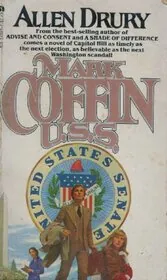
Mark Coffin U.S.S.
by Allen Drury
1979
Thirty-year-old Mark Coffin wins a surprise Senate seat and arrives in Washington full of ideals. Committee fights, powerful in-laws, and a personal scandal quickly teach him how rough public life can be.
Egypt
by Allen Drury
1980
Part travel book and part historical reflection, this volume follows Drury's journey from Abu Simbel to Alexandria. He mixes personal impressions with clear, enthusiastic writing about ancient Egyptian history, religion, and culture.

The Hill of Summer
by Allen Drury
1981
A new American president confronts an aggressive Soviet leader and a world sliding toward confrontation. Drury builds the tension through diplomats, politicians, and insiders who know one bad move could change everything.
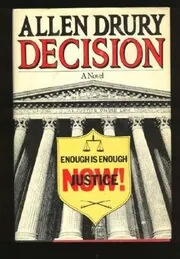
Decision
by Allen Drury
1983
New Supreme Court Justice Tay Barbour is hit by personal disaster just as a terrorist case rises toward the Court. His principles on life, death, and justice suddenly become painfully personal.
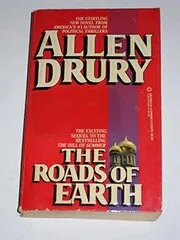
The Roads of Earth
by Allen Drury
1984
President Hamilton Delbacher faces Soviet pressure across several flashpoints, with the superpowers edging toward nuclear catastrophe. This sequel widens Drury's Washington world into a global showdown of strategy, nerve, and miscalculation.
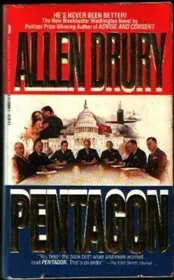
Pentagon
by Allen Drury
1986
A remote Pacific occupation by the Soviets should demand a clear American response. Instead, Drury turns the crisis into a grim study of bureaucracy, rivalry, and paralysis inside the military and government.

The Destiny Makers
by Allen Drury
1988
A Soviet seizure of a remote Pacific atoll exposes how slowly Washington can move in a real emergency. As the invaders dig in, Pentagon infighting and political delay threaten to become the real disaster.
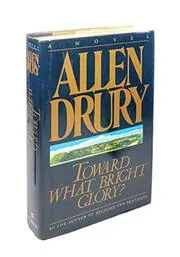
Toward What Bright Glory?
by Allen Drury
1990
On a California campus modeled on Stanford, fraternity brothers face senior year with Europe sliding toward war. College politics, friendship, romance, and ambition suddenly feel less private when history is closing in.
Into What Far Harbor?
by Allen Drury
1993
The men of Alpha Zeta return from World War II expecting peace and find a harder world waiting. As careers, marriages, children, and later wars reshape their lives, survival turns out to be only the beginning.

A Thing of State
by Allen Drury
1995
When two oil kingdoms go to war and a nuclear armed ruler raises the stakes, Washington is forced into a Middle East crisis. Drury follows the State Department, the White House, and the United Nations as every choice grows more dangerous.
Public Men
by Allen Drury
1998
The surviving Alpha Zetas gather for a last reunion as aging Senator Willie Wilson looks back on family losses, old friendships, and a long political life. The past keeps colliding with the public battles that shaped him.
Where to start with Allen Drury
If you want the classic Washington saga: Advise and Consent → A Shade of Difference → Capable of Honor → Preserve & Protect
If you want linked Washington novels outside the main series: Anna Hastings → Mark Coffin U.S.S. → The Hill of Summer → The Roads of Earth
If you want historical intrigue: A God Against the Gods → Return To Thebes
If you want a campus to politics epic: Toward What Bright Glory? → Into What Far Harbor? → Public Men
If you want standalones about institutions under pressure: The Throne of Saturn → Decision → A Thing of State
Allen Drury sub-series and character series
Allen Drury collections, short stories, and related book types
Non-Fiction
Standalone Allen Drury books
Author bio
Allen Drury was born in Houston, Texas, on September 2, 1918, and grew up in Porterville, California. He studied journalism at Stanford and graduated in 1939 after writing columns, editorials, and student-paper copy. Those years stayed with him. Decades later, they would feed the University novels he wrote at the end of his life.
He started out as a newspaperman, not a novelist.
After Stanford he worked at the Tulare Bee, where an editorial he wrote won a Sigma Delta Chi award, and then at the Bakersfield Californian. During World War II he served in the Army. In late 1943 he found the assignment that shaped nearly everything that followed, Senate correspondent for United Press in Washington. He watched Congress up close, saw how senators behaved in public and in private, and kept a detailed journal of the people and power around him.
The Senate changed everything.
Drury kept building a newspaper career, moving through freelance work, Pathfinder, the Washington Evening Star, and eventually The New York Times. All the while he was working on the book that became Advise and Consent. When it appeared in 1959, it felt as if somebody had finally put the machinery of Washington on the page without cleaning it up first. The novel won the Pulitzer Prize for Fiction in 1960, stayed on the bestseller list for an unusually long time, and later became both a Broadway play and a film.
After that, books became the main job.
He spent the next decades returning, again and again, to the places where public decisions get made. A Shade of Difference, Capable of Honor, and Preserve and Protect widen the world of Advise and Consent into the United Nations, presidential campaigns, and Cold War pressure points. Anna Hastings shifts toward the Washington press corps and the rise of a formidable newspaperwoman. Even when he left Washington, he kept the same basic interest in systems and power. The Throne of Saturn turns the race to Mars into a fight over bureaucracy, ego, and national purpose, while A God Against the Gods and Return To Thebes bring the same fascination with belief and control to ancient Egypt. Readers who like Drury usually like the big casts, the insider detail, and the sense that history gets made by flawed people in rooms, not by abstractions.
That mix explains why his books can feel so different on the surface and so similar underneath. He kept returning to institutions, the Senate, the press, the White House, the courts, the space program, because they let him test character under pressure. His novels are full of senators, presidents, reporters, priests, astronauts, and strivers of every kind. Even the late University books, Toward What Bright Glory?, Into What Far Harbor?, and Public Men, keep asking a very Drury question: what happens to people, and to a country, when ambition meets history and then has to live with the result?
He lived in Tiburon, California, from 1964 onward and remained a notably private man. He never married. He finished Public Men, his twentieth novel, just two weeks before he died of cardiac arrest in San Francisco on September 2, 1998, his eightieth birthday. That ending feels almost too neat for a novelist, but the work he left behind is anything but tidy. It is busy, argumentative, sometimes sprawling, and always deeply interested in how power really works.





Edited by
Software engineer whose passion for tracking book recommendations from podcasts inspired the creation of MRB.
Lead investor at 3one4 Capital whose startup expertise and love for books helped shape MRB and its growth.
Comments
Did we miss something? Have feedback?
Help us improve this page by sharing your thoughts